Miranda Rights: What They Are, When They Apply & DUI Arrests
Learn what Miranda Rights mean, when police generally must provide Miranda warnings, how the rule differs from ordinary traffic stops, and what Miranda can mean during a DUI arrest or checkpoint encounter.

What Are Miranda Rights?
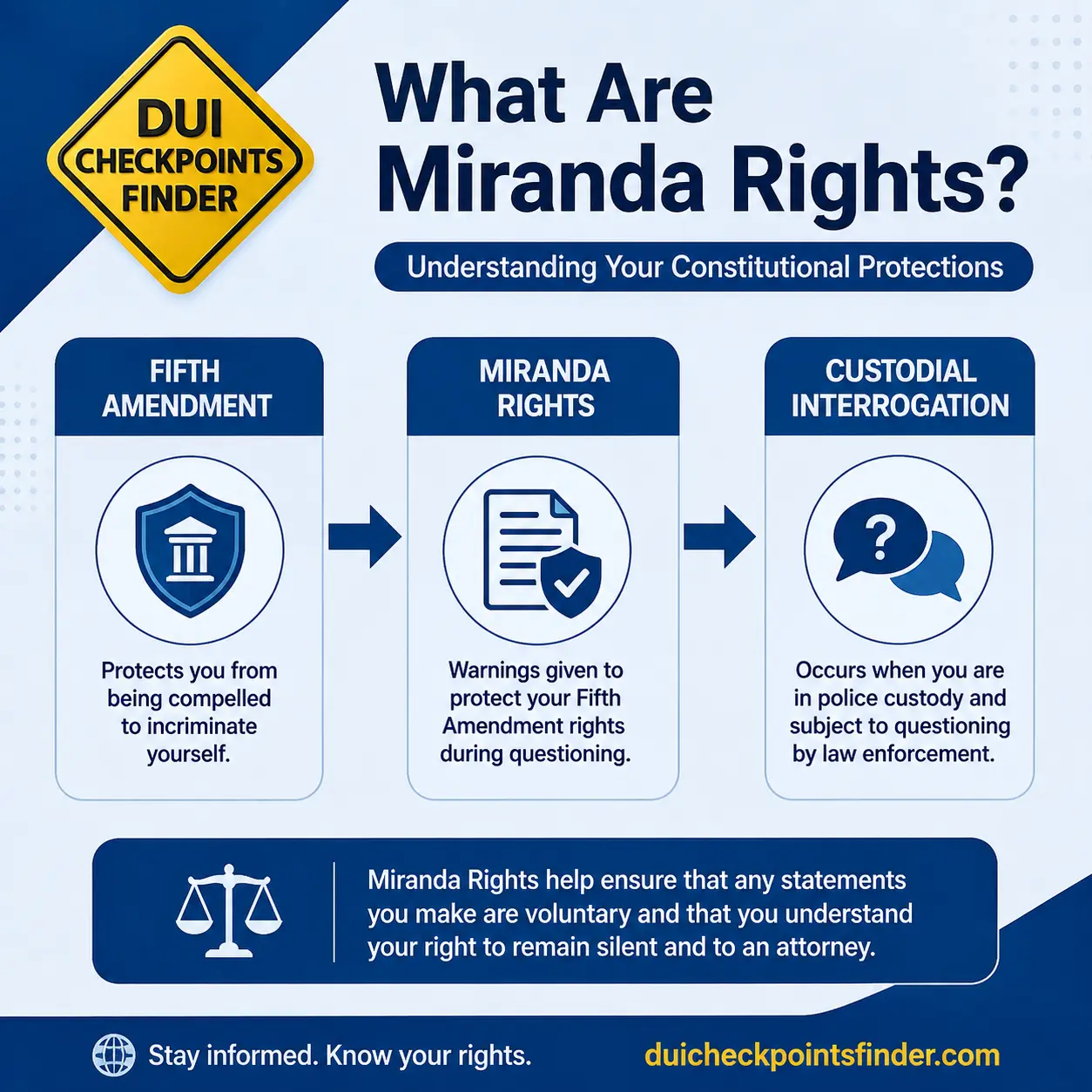
Miranda Rights, also called Miranda warnings, are constitutional safeguards associated with custodial interrogation by law enforcement. They come from the U.S. Supreme Court’s 1966 decision in Miranda v. Arizona.
The purpose of the Miranda rule is to protect the Fifth Amendment privilege against compelled self-incrimination during custodial interrogation. The Supreme Court held that before custodial questioning, law enforcement must provide warnings designed to make a person aware of the right to remain silent and the right to counsel.
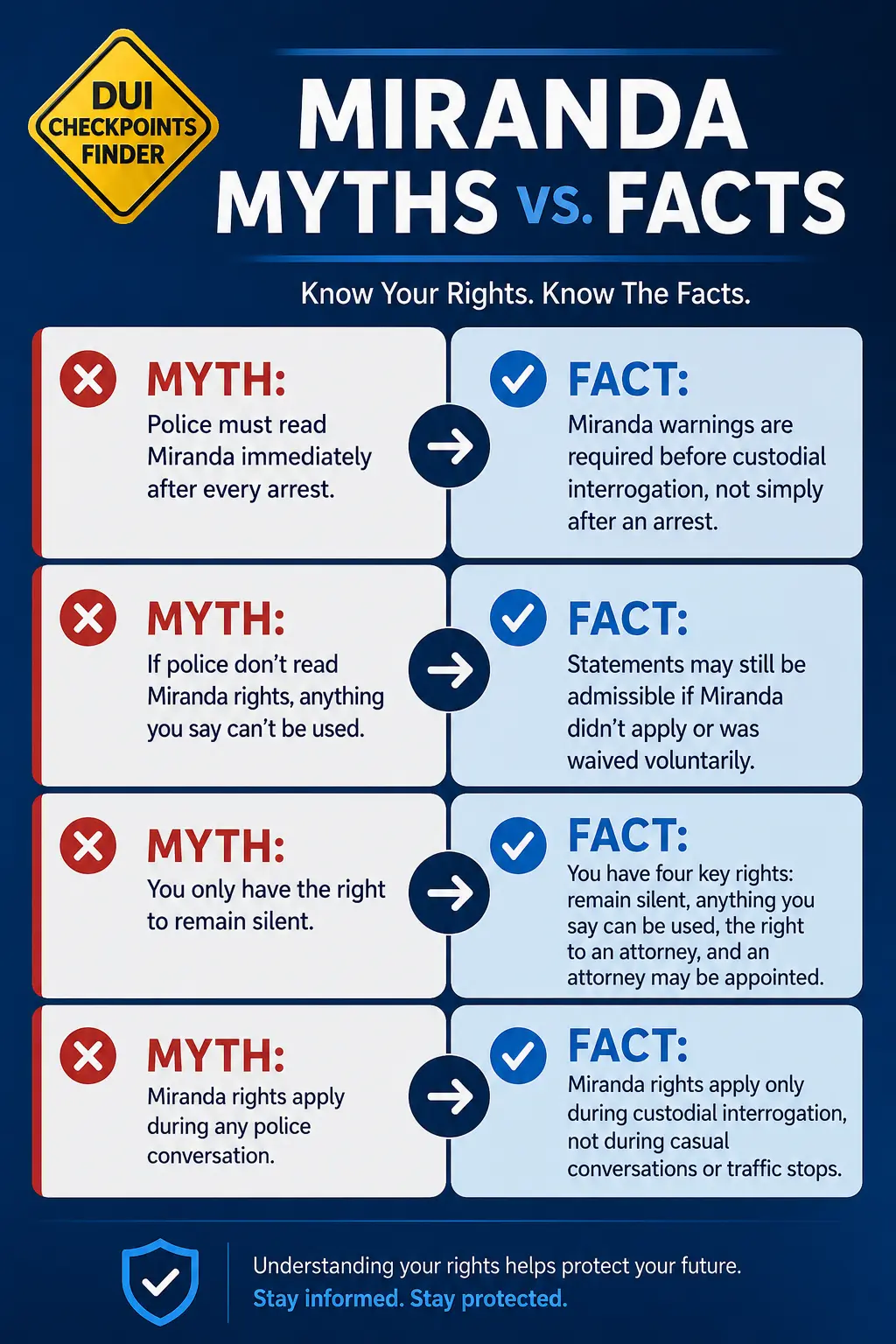
One of the most important points to understand is that Miranda is not simply an “arrest rule.” The constitutional issue generally involves both custody and interrogation. That distinction is particularly important during DUI investigations because a roadside encounter can involve several different stages.
Whether an encounter is custodial depends on the circumstances. Courts generally examine the objective circumstances surrounding the questioning and whether the restraint is comparable to formal arrest.
What Are the Miranda Warnings?
There is not one universally required word-for-word script used by every police department. The wording can vary, but the warnings must communicate the constitutionally required rights.
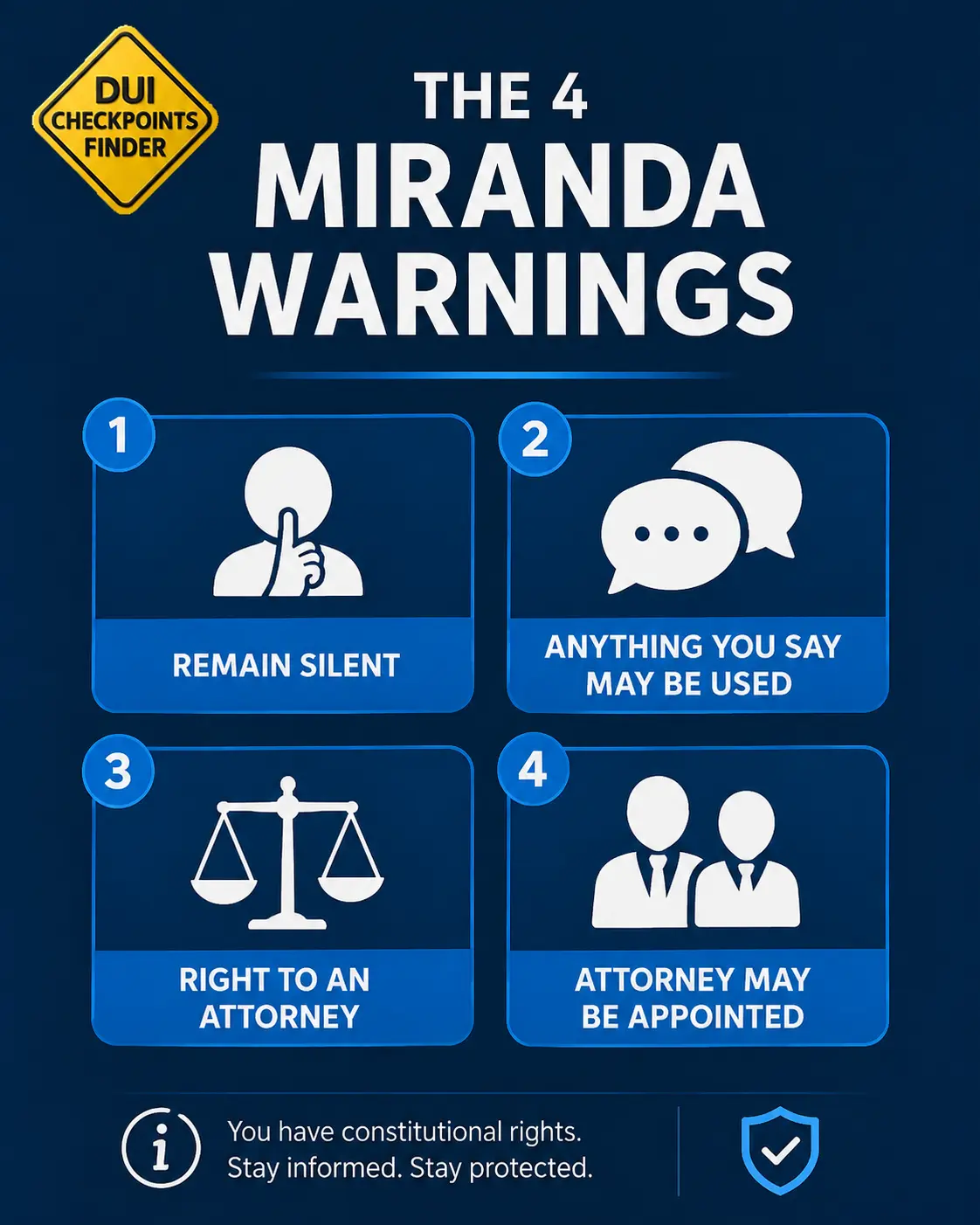
1
Right to Remain Silent
A person must be informed that they have the right to remain silent during custodial interrogation. This protects the privilege against compelled self-incrimination.
2
Statements Can Be Used
The warning must explain that statements made by the person can potentially be used as evidence against them in court.
3
Right to an Attorney
A person must be informed of the right to consult with an attorney and to have an attorney present during custodial questioning.
4
Appointed Counsel
If the person cannot afford an attorney, the Miranda warning includes the right to have counsel appointed before questioning when the constitutional requirements apply.
When Do Miranda Rights Apply?
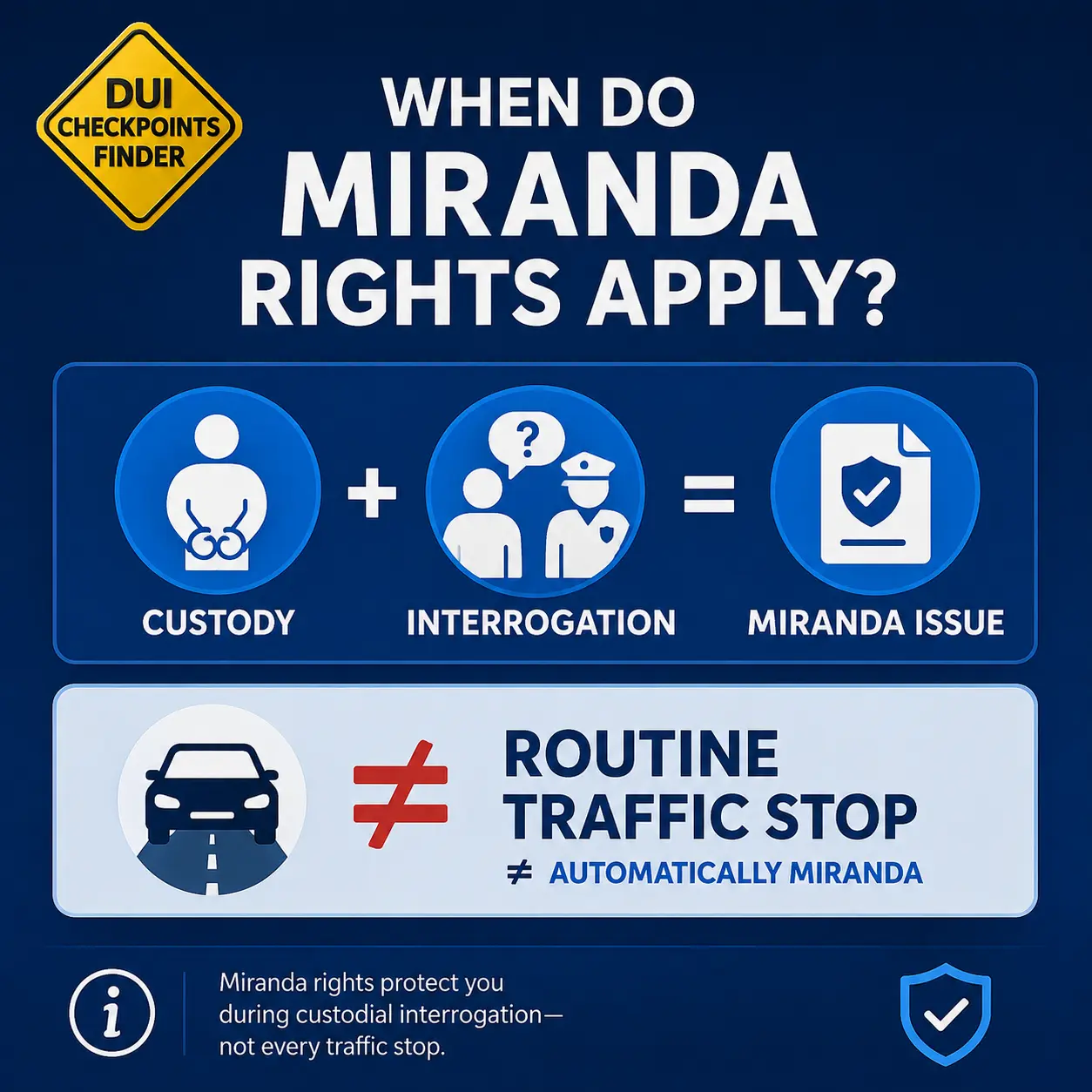
The basic Miranda analysis has two central components: custody and interrogation.
What Does “Custody” Mean?
For Miranda purposes, custody is more specific than simply being contacted by a police officer. Courts consider the circumstances surrounding the encounter and whether the person’s freedom has been restrained to a degree comparable to formal arrest.
What Does “Interrogation” Mean?
Interrogation generally refers to police questioning or its functional equivalent that is designed to elicit an incriminating response. Miranda is focused on custodial interrogation rather than every conversation between an officer and a member of the public.
Why Both Concepts Matter
Does Being Arrested Automatically Trigger Miranda?
No. An arrest and a Miranda warning are related but distinct legal concepts.
A person can be arrested without being immediately interrogated. Miranda is principally concerned with custodial interrogation. If police have taken someone into custody but are not interrogating that person, the Miranda warning requirement is not necessarily triggered merely because the arrest occurred.
Conversely, if police intend to conduct custodial interrogation, Miranda warnings generally must be provided before the questioning covered by the constitutional rule begins.
Miranda Rights During a Traffic Stop
A routine traffic stop does not automatically become a Miranda situation simply because an officer stops a driver and asks questions.
Traffic stops involve temporary investigative detention, and the Miranda implications of ordinary roadside questioning depend on the circumstances. The exact degree of restraint, duration, police conduct, and nature of questioning can matter.
This means a driver should not assume either of the following:
- “The officer did not read Miranda, so nothing I said matters.”
- “The officer stopped me, so Miranda must have been required immediately.”
Neither statement is a reliable description of the law. Miranda generally turns on the circumstances of custodial interrogation.
Do Police Read Miranda Rights at DUI Checkpoints?
Not automatically. A DUI checkpoint generally begins as a brief roadside encounter. The fact that a driver is stopped at a checkpoint does not, by itself, establish that Miranda warnings are required.
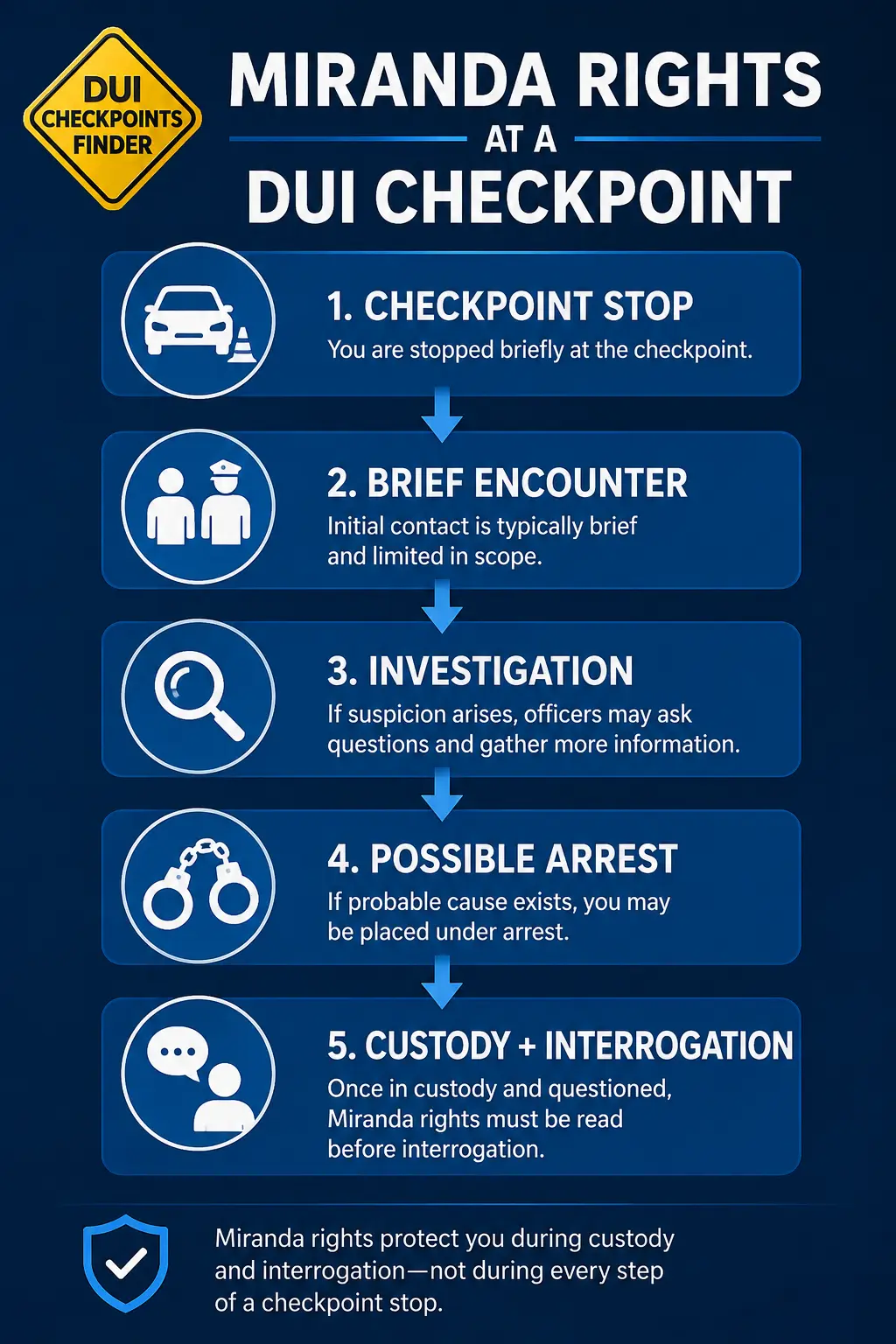
Officers may conduct an initial investigation and ask questions without the encounter necessarily becoming custodial interrogation. If the circumstances later involve custody and interrogation, the Miranda analysis can change.
The important legal distinction is between the checkpoint stop itself and a later stage of the encounter in which the driver may be taken into custody and questioned.
What Happens When a DUI Checkpoint Leads to an Arrest?
A checkpoint encounter can develop into a more serious law-enforcement interaction if officers believe they have grounds for further investigation or arrest.
If a person is in custody and police seek to interrogate that person, Miranda warnings generally become relevant before the custodial questioning begins.
The precise legal analysis depends on what happened, where it happened, what officers said or did, whether the person was free to leave, and whether the questioning constituted interrogation.
Can Police Ask Questions Before Reading Miranda Rights?
Sometimes, yes. Miranda does not mean that every question asked by police requires a warning first.
The Supreme Court’s decision distinguished custodial interrogation from general on-the-scene questioning and from statements that a person voluntarily provides without being subjected to custodial interrogation.
What Happens If Police Do Not Read Miranda Rights?
Failure to provide Miranda warnings does not automatically mean that a DUI charge or criminal case disappears.
The principal issue is generally whether statements obtained through custodial interrogation can be used in the prosecution’s case. Miranda is not a general rule that invalidates every piece of evidence obtained during an investigation.
Miranda Question
Were the person’s constitutional rights properly protected before custodial interrogation?
Case Question
What other evidence, procedures, charges, and legal issues exist in the case?
Can You Waive Miranda Rights?
Yes. A person can choose to speak after receiving Miranda warnings, but the legal validity of a waiver depends on the circumstances.
The Supreme Court has described a valid waiver as requiring a voluntary, knowing, and intelligent decision to relinquish the applicable rights.
How Do You Invoke the Right to Remain Silent?
Miranda protects the right to remain silent during custodial interrogation. If a person wishes to exercise that right, clarity is important because the legal consequences of an alleged invocation can depend on the exact circumstances and wording used.
Similarly, a request for counsel can have significant legal consequences. The Supreme Court has developed additional rules governing what happens after a person invokes the right to counsel during custodial interrogation.
Miranda Rights vs. Other DUI Rights
Miranda Rights are only one part of the legal issues that can arise during a DUI investigation or arrest.
| Issue | What It Generally Concerns |
|---|---|
| Miranda Rights | Constitutional safeguards associated with custodial interrogation. |
| Fifth Amendment | The privilege against compelled self-incrimination. |
| Right to Counsel | Legal representation in situations where the applicable constitutional or statutory right exists. |
| Fourth Amendment | Searches, seizures, and the reasonableness of government intrusion. |
| Field Sobriety Testing | Roadside investigative procedures governed by applicable law and circumstances. |
| Breath, Blood or Urine Testing | Chemical-testing requirements governed by separate constitutional, statutory, and administrative rules. |
| Driver’s License Consequences | Administrative and/or criminal consequences that may arise under state law. |
For a broader overview of rights and legal issues associated with DUI encounters, see our DUI Rights resource.
Miranda Rights and DUI Breath or Blood Tests
Miranda Rights and DUI chemical testing are separate legal questions.
The fact that Miranda warnings were or were not provided does not by itself answer whether a breath, blood, or urine test is legally permitted, whether a person must comply with a particular testing requirement, or what consequences may follow from refusing a test.
Those questions can involve state implied-consent laws, warrants, exceptions, constitutional search-and-seizure principles, administrative license rules, and other state-specific requirements.
Common Miranda Rights Myths vs. Facts
Real-World DUI Examples
Example 1: Routine Checkpoint Stop
A driver reaches a DUI checkpoint and is briefly stopped. The officer asks routine questions and conducts the initial interaction. The fact that the vehicle is stopped does not automatically mean Miranda warnings are required.
Example 2: Investigation Becomes an Arrest
The encounter develops and the driver is taken into custody. If officers then begin custodial interrogation, Miranda becomes relevant before the questioning covered by the constitutional rule.
Example 3: Voluntary Statement
A person voluntarily makes a statement without being subjected to custodial interrogation. Volunteered statements are treated differently from statements produced through custodial interrogation.
Example 4: Request for Counsel
A person invokes the right to counsel during custodial questioning. Additional constitutional rules can govern whether and when police may resume questioning.
Miranda Rights in California
Miranda is a federal constitutional doctrine, but DUI cases in California are also governed by California statutes, court decisions, administrative rules, and other state-specific procedures.
California drivers may encounter additional legal questions involving DUI investigations, chemical testing, driver’s license consequences, and other procedures. Miranda should therefore not be treated as a complete explanation of California DUI rights.
If you are dealing with an actual California DUI arrest or criminal investigation, a California attorney can evaluate the specific circumstances and explain which rules apply.
What Should You Do After a DUI Arrest?
A DUI arrest can involve serious legal and administrative consequences. General safety and legal-information principles include:
- Remain calm. Do not physically resist law enforcement.
- Do not provide false information.
- Understand the difference between a traffic stop and custodial interrogation.
- If custodial questioning occurs, understand your Miranda protections.
- Consider requesting legal counsel when appropriate to your circumstances.
- Contact a qualified DUI attorney if you need advice about a specific arrest or case.
- Never drive while impaired. Plan a sober ride before consuming alcohol or using any impairing substance.
Looking for More DUI Rights Information?
Miranda is only one part of the legal issues that can arise during a DUI stop, checkpoint, investigation, or arrest.
Frequently Asked Questions About Miranda Rights
1. What are Miranda Rights?
Miranda Rights are constitutional safeguards associated with custodial interrogation. They generally require law enforcement to inform a person of specified rights before custodial questioning.
2. When do police have to read Miranda Rights?
Miranda warnings generally must be provided before custodial interrogation. Both custody and interrogation are central to the analysis.
3. Do police have to read Miranda Rights when they arrest you?
Not necessarily immediately. An arrest by itself does not automatically establish the Miranda requirement. The rule generally becomes relevant when police conduct custodial interrogation.
4. Do Miranda Rights apply during a DUI checkpoint?
Not automatically. A checkpoint stop does not by itself establish custodial interrogation. The circumstances can change if the encounter develops into custody followed by interrogation.
5. Do Miranda Rights apply during a traffic stop?
Not automatically. Routine traffic stops and custodial interrogation are different legal concepts. The circumstances and degree of restraint matter.
6. Can police ask questions before reading Miranda Rights?
Some questioning can occur without Miranda warnings when the constitutional requirements for custodial interrogation are not present. The exact circumstances matter.
7. What happens if police do not read Miranda Rights?
The absence of a Miranda warning does not automatically dismiss a DUI case. The issue generally concerns the admissibility of statements obtained through custodial interrogation without the required safeguards.
8. Can a DUI case be dismissed because Miranda was not read?
Not automatically. A Miranda issue may affect particular statements, but it does not necessarily invalidate all other evidence or eliminate every charge.
9. Can Miranda Rights be waived?
Yes. A waiver can be valid when the legal requirements are satisfied, including that the waiver is voluntary, knowing, and intelligent.
10. Do Miranda Rights protect against DUI breath or blood testing?
Miranda and chemical-testing requirements are separate legal issues. Breath, blood, and urine testing can be governed by different constitutional, statutory, and administrative rules.
11. Do Miranda Rights apply to every question a police officer asks?
No. Miranda is specifically associated with custodial interrogation. Not every conversation or investigative question is automatically covered by the Miranda rule.
12. Are Miranda Rights the same in every state?
The constitutional Miranda requirement applies throughout the United States, but warning language and related procedures can vary by jurisdiction. State law can also provide additional protections.
13. What is the difference between Miranda Rights and the Fifth Amendment?
The Fifth Amendment protects against compelled self-incrimination. Miranda established procedural safeguards designed to protect that privilege during custodial interrogation.
14. What is the difference between Miranda Rights and DUI rights?
Miranda focuses on custodial interrogation. DUI rights can involve many additional legal issues, including searches, chemical testing, driver’s license consequences, and other procedures.
15. Should I talk to a lawyer after a DUI arrest?
If you are dealing with an actual DUI arrest or criminal investigation, consulting a qualified attorney can help you understand the laws and procedures applicable to your specific circumstances.
Miranda Rights: The Bottom Line
Miranda Rights are primarily about custodial interrogation. A person generally must be warned of the applicable rights before law enforcement conducts custodial questioning. However, a routine traffic stop, DUI checkpoint stop, or arrest does not automatically mean that Miranda warnings are required at that exact moment.
For DUI cases, the distinction is especially important because a single encounter can move through multiple stages. The legal significance of a statement may depend on when it was made, whether the person was in custody, whether police were interrogating the person, whether Miranda warnings were given, whether rights were waived or invoked, and what other evidence exists.
Understanding Miranda Rights can help the public better understand constitutional protections without confusing Miranda with every other right or procedure involved in a DUI investigation.
Legal & Educational Disclaimer: The information on this page is provided for general educational and informational purposes only. DUI, criminal procedure, Miranda, chemical testing, driver’s license, search-and-seizure, and other laws vary by jurisdiction and can change over time. This page does not provide legal advice, create an attorney-client relationship, or guarantee any particular legal outcome. If you have been arrested, charged, questioned, or investigated for DUI or another offense, consult a qualified attorney licensed in the applicable jurisdiction for advice about your specific circumstances.
Sources & Further Reading
The following authoritative legal materials provide background for the information discussed on this page:
- Miranda v. Arizona, 384 U.S. 436 (1966) — U.S. Supreme Court decision establishing Miranda safeguards for custodial interrogation.
- U.S. Constitution, Fifth Amendment — Constitutional protection against compelled self-incrimination.
- U.S. Constitution Annotated — Custodial Interrogation Standard — Legal discussion of custody and interrogation.
- Legal Information Institute — Miranda Rule — Educational explanation of the Miranda doctrine.
Editorial note: Legal information on this page is intended to explain general principles. Specific cases can depend on jurisdiction, facts, timing, and subsequent court decisions.