Important: DUI laws and procedures vary by state and circumstance. This page provides general educational information about DUI-related rights and responsibilities. It is not legal advice and does not determine whether a particular traffic stop, checkpoint, search, arrest, or test was lawful.
Quick Answer: What Rights Do You Have During a DUI Stop?
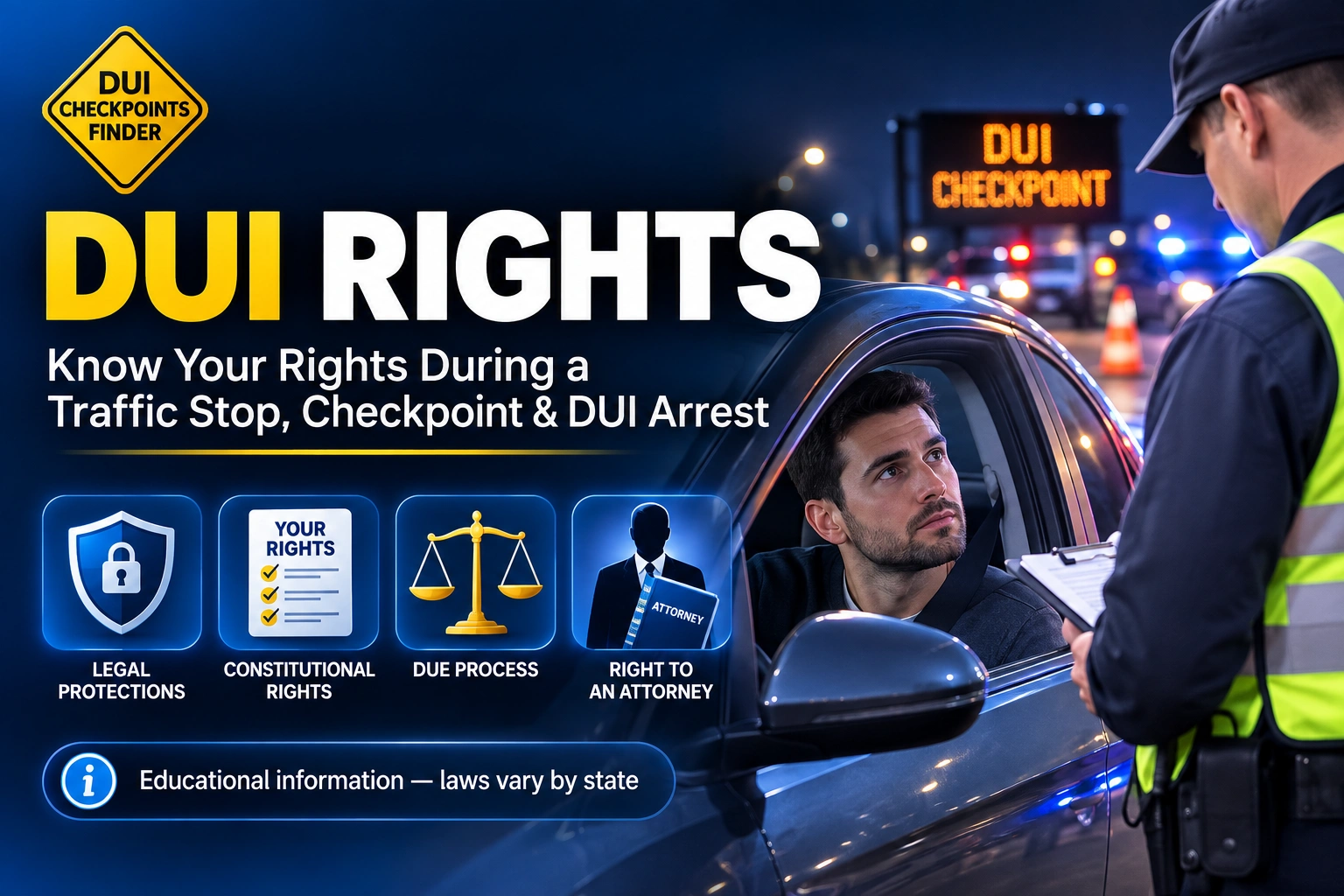
A person involved in a DUI investigation may have important constitutional and statutory protections, including protections involving self-incrimination, custodial interrogation, searches and seizures, counsel, due process, and chemical testing. However, these protections do not all apply in the same way or at the same point in an encounter.
The most important distinction is this: a traffic stop, DUI checkpoint, DUI investigation, arrest, and custodial interrogation are legally different situations. The rights and obligations that apply can change as the encounter develops.
Understanding Your Rights in a DUI Case
A DUI encounter can involve several different legal events. A driver may first be stopped, then questioned, asked to participate in roadside testing, subjected to a chemical test under applicable state law, arrested, and later required to appear in court or deal with administrative driver’s-license consequences.
These stages are not legally identical. The constitutional rules governing a police question may be different from the rules governing a vehicle search or a chemical test. Understanding those distinctions can help you understand reliable DUI information without confusing one legal protection with another.
DUI Checkpoints Finder provides this information for public education and safety. It does not provide instructions for avoiding or evading law enforcement. If alcohol or drugs may have impaired you, the safest decision is not to drive.
Your Rights During a DUI Traffic Stop
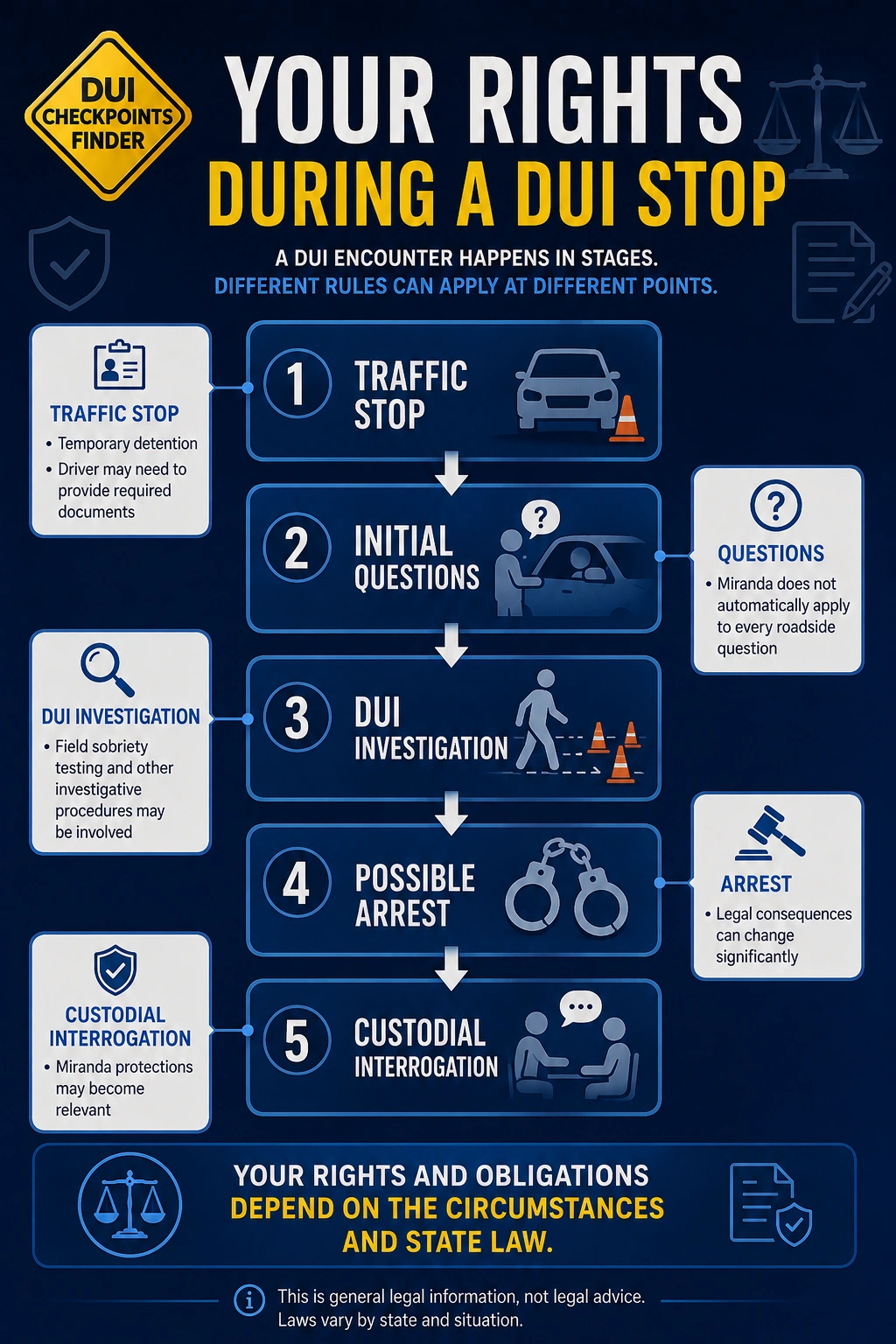
A traffic stop is generally a temporary law-enforcement detention. A DUI investigation can develop during that stop if an officer observes facts that raise concerns about impairment or another violation.
The Stop
A traffic stop is a seizure under the Fourth Amendment and must satisfy applicable constitutional and legal requirements.
Questions
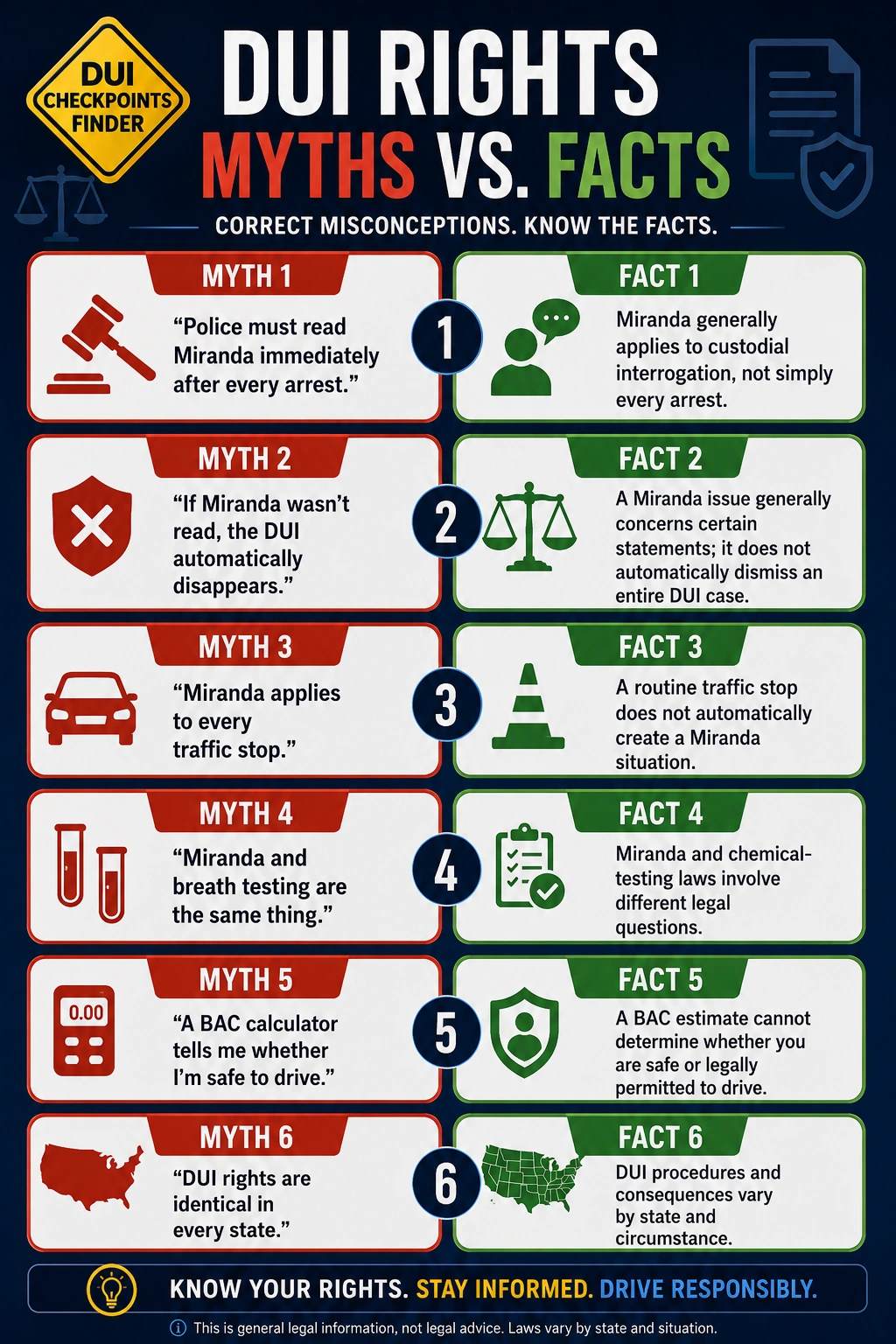
Officers may ask questions during a roadside encounter. Miranda does not automatically apply to every question asked during every traffic stop.
Investigation
Depending on the circumstances, officers may investigate possible impairment using observations, field sobriety testing, or other procedures permitted by law.
Possible Arrest
If officers develop sufficient legal grounds, an encounter may progress to an arrest. Different legal protections can become relevant at this stage.
Important: Do not confuse having legal rights with having permission to physically resist, obstruct an officer, provide false information, or create an unsafe situation. Legal challenges are generally addressed through the appropriate legal process.
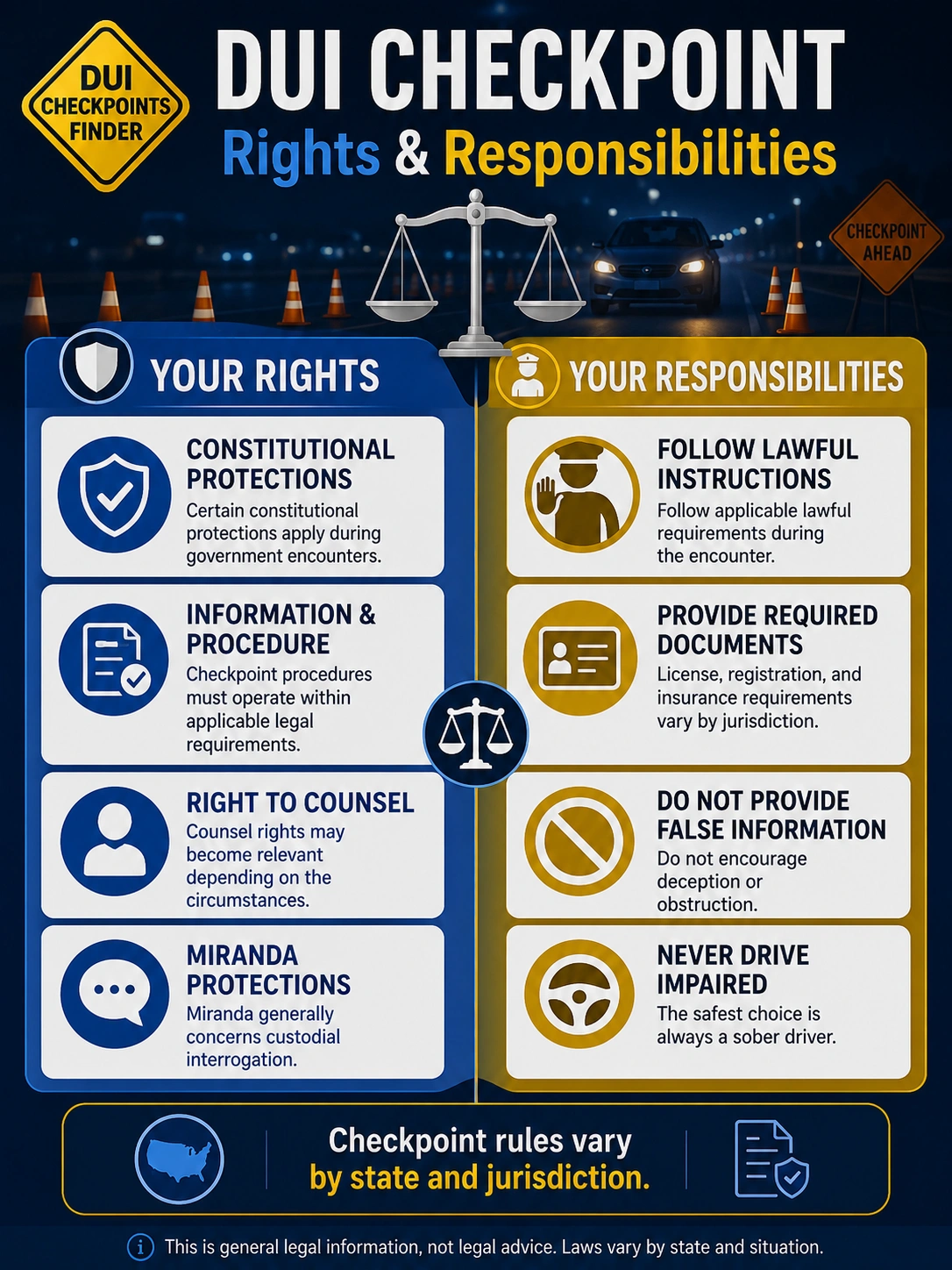
DUI Checkpoint Rights & Responsibilities
DUI checkpoints, sobriety checkpoints, and driver’s-license checkpoints can operate under specific constitutional and state-law requirements. The exact rules are not identical across the United States.
At a checkpoint, a driver may encounter a brief initial interaction followed by additional investigation if officers observe facts suggesting impairment or another violation. The legal analysis can depend on the checkpoint’s operation, jurisdiction, and the specific facts of the encounter.
Your Rights
- Constitutional protections still apply.
- Search-and-seizure rules may apply to the encounter.
- Miranda may become relevant if custodial interrogation occurs.
- You may have rights to counsel at applicable stages.
Your Responsibilities
- Follow lawful instructions.
- Provide documents when legally required.
- Do not provide false information.
- Do not physically interfere with law enforcement.
- Never drive while impaired.
Looking for publicly announced DUI checkpoint information?
Miranda Rights in a DUI Case
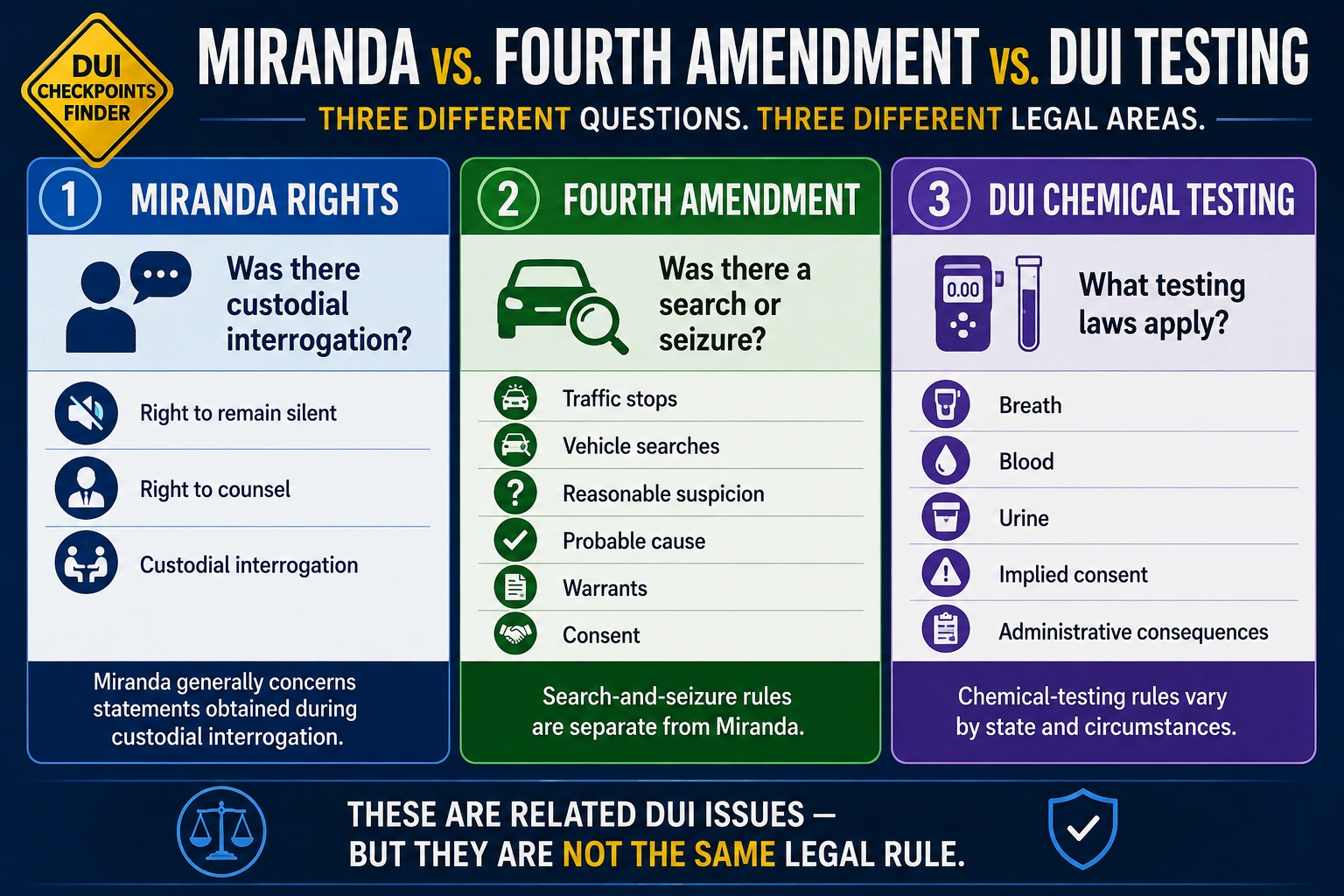
Miranda Rights are protections associated with custodial interrogation. The key question is not simply whether someone has been stopped or arrested. Miranda generally concerns situations in which a person is in custody and subjected to interrogation.
The Core Rule
Custody + interrogation = the central Miranda question.
A routine traffic stop does not automatically require Miranda warnings simply because an officer asks questions. Similarly, an arrest by itself does not mean that every statement made afterward is automatically covered by the Miranda rule. The specific circumstances matter.
Miranda issues also should not be confused with the Fourth Amendment, chemical-testing rules, or the general right to counsel. These are related areas of law but involve different legal questions.
The Right to Remain Silent
The Fifth Amendment protects against compelled self-incrimination. In the Miranda context, the right to remain silent is particularly important during custodial interrogation.
However, the right to remain silent should not be confused with a general exemption from lawful identification or documentation requirements. What a driver must provide during a traffic stop can depend on state law and the circumstances.
You can have constitutional protections while still having legal obligations during a traffic stop. Do not assume that every request from an officer is optional or that every question has the same legal significance.
If you are involved in a real criminal investigation and are unsure how to respond to questioning, obtaining advice from a qualified attorney in the relevant jurisdiction is more reliable than relying on general internet information.
Right to an Attorney
The right to counsel involves more than a single constitutional rule. The Sixth Amendment, Miranda doctrine, and state procedures can operate at different stages of a criminal case.
During Questioning
A request for counsel can have important consequences during custodial interrogation under Miranda doctrine.
Criminal Proceedings
The right to counsel also applies at constitutionally significant stages of a criminal prosecution.
Legal Advice
A qualified attorney can evaluate the specific facts, jurisdiction, evidence, and procedural history of an individual DUI matter.
Fourth Amendment Rights in a DUI Investigation
The Fourth Amendment protects against unreasonable searches and seizures. In DUI cases, Fourth Amendment questions can arise during traffic stops, checkpoint encounters, vehicle searches, arrests, and certain evidence-gathering procedures.
Whether the stop was legally justified can matter.
Searches may require legal justification or a recognized exception.
Checkpoint programs are subject to constitutional requirements.
The legality of obtaining evidence can become an issue in a criminal case.
There is no single rule that says police always need a warrant before every DUI-related search. Constitutional law recognizes circumstances in which a warrant is not required. Whether a particular search or seizure was lawful depends on the facts and applicable law.
If you believe evidence was obtained unlawfully, that issue is generally addressed through the appropriate legal process rather than by physically resisting an officer at the roadside.
Field Sobriety Tests and DUI Rights
Field sobriety testing is different from chemical testing. Standardized field sobriety tests are roadside investigative procedures used by officers when evaluating possible impairment.
Horizontal Gaze Nystagmus
An eye-movement test commonly associated with standardized field sobriety testing.
Walk-and-Turn
A divided-attention test involving instructions, balance, and movement.
One-Leg Stand
A balance and divided-attention test used as part of standardized roadside evaluation.
The legal rules concerning whether a driver may decline a field sobriety test, and what consequences may follow, vary by jurisdiction. Do not assume that a rule from one state applies nationwide.
Breath, Blood and Other Chemical Tests
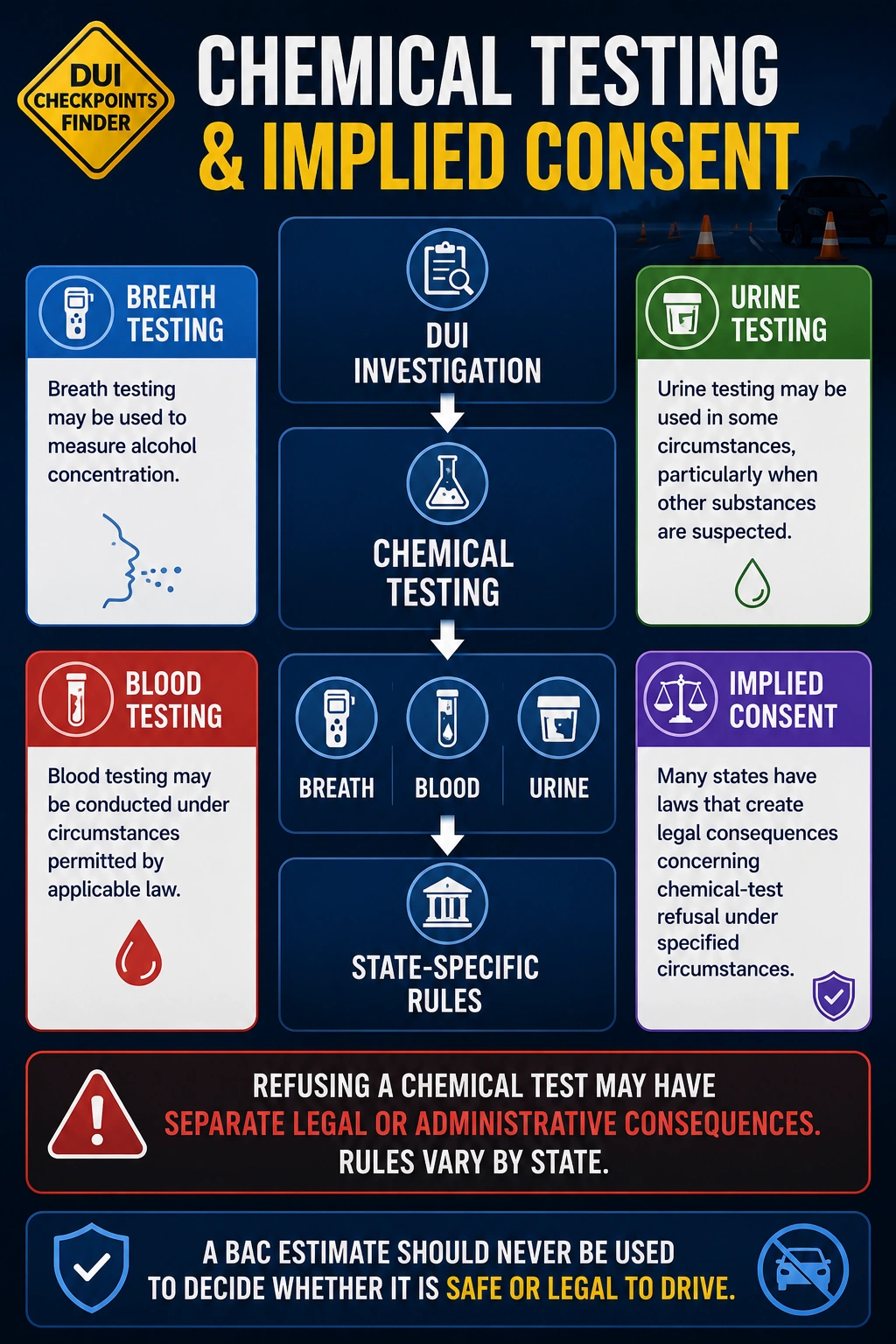
Chemical testing is a separate legal issue from Miranda. Depending on the jurisdiction and circumstances, DUI investigations can involve breath, blood, urine, or other testing methods.
Breath
Breath-testing procedures and evidentiary rules vary by jurisdiction.
Blood
Blood testing can involve additional legal and procedural requirements.
Urine
Urine testing may be used in certain circumstances, including some drug-related investigations.
What Is Implied Consent?
Implied-consent laws generally establish rules concerning chemical testing for suspected impaired driving. The details differ substantially among states, including when testing may be required, what type of test may be used, and what consequences may follow a refusal.
Depending on the jurisdiction and circumstances, consequences associated with refusing a required chemical test can include driver’s-license or administrative penalties and other legal consequences. The precise outcome cannot be determined from a nationwide rule.
Can You Refuse a Breath or Chemical Test?
The answer depends on the state, the type of test, and the circumstances. Refusal can carry separate consequences, so a person should not assume that refusing a test has no legal effect.
This is one reason DUI chemical-testing questions are highly jurisdiction-specific. If you need advice about a particular test or refusal, consult an attorney familiar with the law where the incident occurred.
BAC, Alcohol and DUI Rights
Blood alcohol concentration, commonly called BAC, is an important concept in alcohol-impaired-driving law. However, a BAC estimate should never be treated as a guarantee that someone is safe or legally permitted to drive.
BAC Is an Estimate
Individual alcohol absorption and elimination can vary, and online calculators cannot measure actual impairment.
Impairment Can Be Dangerous
Alcohol and drugs can affect judgment, reaction time, attention, coordination, and decision-making.
Never Use BAC to Decide to Drive
If you have consumed alcohol or used an impairing substance, choose a sober transportation option.
Want an Educational BAC Estimate?
Our BAC calculator can provide an educational estimate. It is not a breathalyzer, medical device, or legal determination of whether you can drive.
What Rights Do You Have After a DUI Arrest?
An arrest does not end your legal rights. Depending on the jurisdiction and circumstances, important issues can include counsel, self-incrimination, due process, evidence, court procedures, and administrative driver’s-license consequences.
Counsel
You may have rights to legal counsel at applicable stages of a criminal case.
Due Process
Criminal proceedings are subject to constitutional and procedural protections.
Evidence
Evidence can be challenged through the appropriate legal procedures when a legitimate legal issue exists.
Administrative Issues
A DUI arrest may also create separate driver’s-license or administrative proceedings depending on state law.
DUI Rights vs. DUI Responsibilities
Understanding legal rights does not mean ignoring lawful responsibilities. A responsible approach is to know the difference between exercising a legal protection and interfering with an investigation.
| Rights / Protections | Responsibilities |
|---|---|
| Constitutional protections | Follow lawful instructions |
| Protection against compelled self-incrimination | Provide information and documents when legally required |
| Applicable right to counsel | Appear for required court or administrative proceedings |
| Ability to challenge evidence through legal procedures | Do not physically resist or obstruct law enforcement |
DUI Rights and Laws Vary by State
There is no single nationwide DUI procedure covering every traffic stop, checkpoint, field sobriety test, chemical test, arrest, license consequence, and court process. State statutes, regulations, appellate decisions, and local procedures can change the legal analysis.
That is why a nationwide DUI rights guide should explain general constitutional principles while making clear when state-specific law matters.
Find DUI Checkpoint Information by Location
Explore publicly announced DUI checkpoint information organized by state, county, and city.
Common DUI Rights Myths vs. Facts
What Should You Do After a DUI Arrest?
If you have been arrested or believe you are the subject of a DUI investigation, general internet information cannot replace advice about your specific circumstances.
Avoid confrontation or unsafe behavior.
Do not physically interfere with law enforcement.
Know that different legal rules apply at different stages.
A qualified attorney can assess your particular case.
Frequently Asked Questions About DUI Rights
Related DUI Resources
Miranda Rights
Learn when Miranda warnings apply, what custodial interrogation means, and how Miranda relates to DUI encounters.
Read the Miranda Rights Guide →
DUI Checkpoint Locations
Browse publicly announced DUI checkpoint information organized by state, county, and city.
Explore DUI Locations →
BAC Calculator
Use the educational BAC calculator to estimate BAC based on entered information. Never use an estimate to decide whether to drive.
Open BAC Calculator →
Never Drive While Impaired
If alcohol or drugs may affect your driving, do not take the risk. Arrange a sober driver, rideshare, taxi, public transportation, or another safe way home.
DUI Rights Information Disclaimer
This page is provided for general educational and public-awareness purposes only. It is not legal advice, does not create an attorney-client relationship, and should not be relied upon as a substitute for advice from a qualified attorney.
DUI laws, checkpoint procedures, chemical-testing requirements, implied-consent laws, driver’s-license consequences, and constitutional rules can vary by state and by the facts of an individual case.
DUI Checkpoints Finder is an independent informational website and is not a government agency or law-enforcement organization. Information about DUI checkpoints and enforcement operations may change. When legal advice is needed, consult an attorney licensed in the appropriate jurisdiction.